
Modern construction increasingly looks to combine performance with sustainability, particularly when working with older buildings or breathable floor systems. One material that has become widely used in this context is recycled foam glass, often abbreviated as RFG.
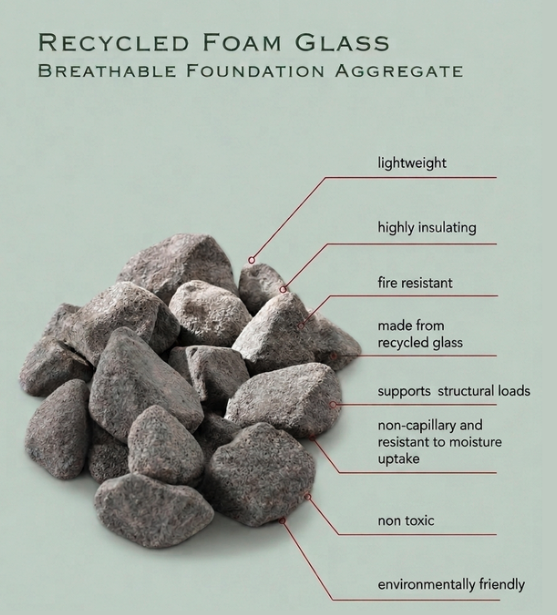
Although it is not always visible once a floor is complete, foam glass plays a critical role within many limecrete sub floor systems. It provides insulation, supports structural loads, and allows moisture to move naturally through the floor, all while being made from recycled materials.
Understanding how foam glass works, and why it is used, is essential when designing or installing a breathable limecrete floor system.
What Is Recycled Foam Glass?
Recycled foam glass is a lightweight aggregate made from recycled glass, typically sourced from post-consumer waste such as bottles and industrial glass products.
The material is produced by heating crushed glass to high temperatures until it expands and forms a cellular, foam-like structure. This process creates a granular material made up of millions of tiny sealed air pockets.
These air pockets give foam glass its unique combination of properties. The material is lightweight, highly insulating, and extremely stable. Because the structure is made up of closed cells, it does not absorb water in the same way as many traditional aggregates, meaning it is non-capillary and resistant to moisture uptake.
In addition, foam glass is chemically inert, non-toxic, and does not contain organic matter. This makes it resistant to rot, pests, and long-term degradation, allowing it to maintain its performance over time.
Because it is made from recycled materials, foam glass is also considered an environmentally responsible alternative to many conventional insulation products.
There are a number of established foam glass products used across the UK and Europe, including materials such as Geocell and other recycled foam glass aggregates. While these products may vary slightly in specification, they all share the same core characteristics of being lightweight, load-bearing, insulating, and vapour permeable. For example, foam glass aggregates like Geocell are designed specifically for below-ground construction and limecrete floor systems, offering strong compressive performance while remaining non-capillary and free draining. These materials can provide high load-bearing capacity alongside thermal insulation, allowing them to replace traditional sub-base materials while supporting breathable construction principles. This technical data sheet explains Geocell in much more detail if you wish to read more.
How Foam Glass Works in a Limecrete Sub Floor System
In a limecrete floor system, foam glass is typically used as part of the sub floor build-up beneath the limecrete screed.
Rather than relying on a single concrete slab, limecrete floors are constructed as layered systems. Each layer plays a role in managing load, insulation, and moisture movement.
Foam glass sits within this structure as the primary insulation layer.
Below the foam glass, a compacted sub-base provides stability. Above it, the limecrete screed forms the structural layer that supports the finished floor.
What makes foam glass particularly effective is that it performs multiple roles within the same layer. It provides insulation, acts as a load-bearing sub-base, and allows moisture to drain and move through the structure. This means it can often replace several traditional materials within a floor build-up, simplifying the overall construction.
Because foam glass combines insulation and drainage in one material, it can also reduce the overall depth of the floor system while still achieving the required thermal performance.
This is one of the reasons foam glass is particularly well suited to limecrete floors, as both materials work together to maintain a vapour permeable construction.
Why Breathability Matters in Floor Construction
To understand the value of foam glass, it is important to first understand the principle of breathable construction.
Traditional buildings were designed to allow moisture to move through the structure and evaporate naturally. Materials such as lime mortar, lime plaster, and solid masonry all support this process.
When impermeable materials such as concrete or plastic membranes are introduced, they can disrupt this natural balance. Moisture becomes trapped rather than being allowed to escape.
This can lead to damp problems, deterioration of finishes, and long-term damage to the building fabric.
A breathable floor system avoids this issue by allowing moisture to move through each layer of the floor.
Foam glass plays a key role in this by providing insulation without blocking moisture movement, while also acting as a capillary break that prevents liquid water from being drawn upward through the structure.
Key Benefits of Recycled Foam Glass
Thermal Insulation
One of the primary functions of foam glass is to improve the thermal performance of the floor.
The air pockets within the material create an effective barrier to heat loss, helping to keep buildings warmer and more energy efficient.
Moisture Management
Unlike many traditional insulation materials, foam glass does not trap moisture.
Its closed-cell structure means it does not absorb water, while the granular form allows moisture to pass between particles and drain freely.
Load Bearing Strength
Despite being lightweight, foam glass is capable of supporting significant loads.
When compacted, it forms a stable and self-locking structure with high compressive strength.
Durability and Stability
Foam glass is an inorganic material, meaning it does not degrade over time.
It is resistant to rot, mould, insects, and ground conditions.
Fire Resistance and Safety
Foam glass is non-combustible and does not release harmful gases.
Sustainability
Foam glass is made from recycled glass, often from post-consumer waste.
Research into recycled foam glass materials has shown that they can be produced with a significantly reduced environmental impact compared to traditional construction materials, supporting their role in more sustainable building practices.
Installation Efficiency
Foam glass is lightweight and easy to handle, making installation quicker and more efficient.
Compatibility with Limecrete
Foam glass works seamlessly with limecrete to create a breathable, high-performing floor system.
Foam Glass vs Traditional Floor Insulation
In many modern floor systems, insulation is provided using rigid boards or synthetic materials.
These materials can trap moisture.
Foam glass differs in that it provides insulation, drainage, and structural support in one breathable layer.
Foam Glass in Heritage and Renovation Projects
Foam glass aligns with traditional building principles and is ideal for:
- listed buildings
- period homes
- conservation projects
Foam Glass and Underfloor Heating
Foam glass plays an important role in improving the performance and efficiency of underfloor heating systems within a limecrete floor build-up. By providing a highly insulating layer beneath the heating system, it helps prevent heat loss into the ground and instead directs warmth upwards into the living space.
This insulation layer ensures that the energy generated by the underfloor heating is used more effectively, reducing warm-up times and improving overall energy efficiency. As a result, the system can maintain comfortable indoor temperatures using less energy compared to floor constructions where heat is lost downward.
When combined with limecrete, the benefits are further enhanced. Limecrete’s thermal mass allows it to absorb heat from the underfloor heating system and release it gradually over time, creating a steady and consistent level of warmth. This helps avoid temperature fluctuations and provides a more comfortable internal environment.
Importantly, this can all be achieved while maintaining a breathable floor system. Unlike impermeable constructions, the combination of foam glass and limecrete allows moisture to continue moving naturally through the floor, ensuring that both thermal performance and moisture management are balanced effectively.
Further detail on how these systems are designed and installed can be found in our underfloor heating guidance.
If you are planning a project and would like advice on combining foam glass, limecrete, and underfloor heating, you can also get in touch with our team through our contact page for tailored guidance.
When Should Foam Glass Be Used?
Foam glass is ideal when:
- installing limecrete floors
- renovating older buildings
- dealing with damp issues
- improving insulation without sealing the structure
Frequently Asked Questions
What is foam glass insulation made from?
Foam glass is made from recycled glass that is heated and expanded into a lightweight aggregate.
Is foam glass waterproof?
It does not absorb water but allows moisture to move through the structure.
Is foam glass suitable for old buildings?
Yes, it supports breathable construction.
Does foam glass provide insulation?
Yes, it has strong thermal performance.
Is foam glass environmentally friendly?
Yes, it is made from recycled materials and has a lower environmental impact.
Can foam glass be used with limecrete?
Yes, it is specifically designed to work with limecrete systems.
Does foam glass support structural loads?
Yes, when compacted it provides a strong, stable base.
Is foam glass long-lasting?
Yes, it is highly durable and resistant to degradation.
Conclusion
Recycled foam glass is a key component in modern limecrete sub floor systems, offering insulation, strength, and breathability in a single material.
By supporting moisture movement while improving thermal performance, it helps create a floor system that works in harmony with traditional building materials.