
Concrete is one of the most widely used construction materials in the modern world. It forms the foundations of modern buildings, supports structural frames, and provides durable ground floor slabs for homes and commercial properties alike. Its strength, predictability, and availability have made it the default flooring material in modern construction for more than a century.
Yet long before cement-based concrete became dominant, builders relied on lime as the primary binding material in construction. Lime mortars, lime plasters, and lime-based flooring systems were used across Britain for centuries. Many historic buildings that still stand today were constructed entirely using lime-based materials that allow structures to breathe and adapt naturally to their environment.
In recent decades there has been renewed interest in these traditional construction methods. Architects, conservation specialists, and homeowners restoring older buildings are increasingly recognising the benefits of breathable construction materials. One material at the centre of this revival is lime.
Although limecrete and concrete can appear similar once installed, they behave very differently as building materials. Their interaction with moisture, flexibility, environmental impact, and suitability for heritage buildings all vary significantly.
Understanding these differences is essential when deciding whether a limecrete floor system or a traditional concrete slab is the most appropriate solution for a particular building.
For a deeper explanation of the material itself, the Limecrete team explain more on their About Limecrete page.
What Is Limecrete?
Limecrete is a type of sub floor made using natural hydraulic lime rather than cement as the binder. It is typically created by mixing lime with aggregates and water to form a solid floor base capable of supporting internal floor finishes such as stone, tile, or timber.
Although limecrete flooring is not as strong as cement, it performs a similar structural role to concrete, though its properties are very different because lime behaves differently from cement.
The defining characteristic of limecrete is that it is vapour permeable, meaning moisture vapour can move through the material rather than becoming trapped beneath the floor. This breathability allows the floor to regulate moisture naturally within the building.
Historically, lime-based construction materials were widely used across Europe before the industrial production of cement became widespread in the nineteenth century. Lime mortars, lime plasters, and lime floors were all common because they worked well with traditional building materials such as stone, brick, and timber.
Modern limecrete flooring continues these traditional principles while incorporating contemporary construction techniques such as insulation layers and underfloor heating compatibility.
A helpful introduction to how lime works as a building material can be found in this guide from Critical Concrete, which explains the science behind lime-based construction and its role in sustainable building.
What Is Concrete?
Concrete is produced by mixing Portland cement with sand, aggregates such as gravel, and water. When combined, these ingredients undergo a chemical reaction called hydration. This reaction causes the cement to bind the aggregates together and form a dense, rigid material.
Because of its strength and durability, concrete has become the most common material used for modern floor slabs.
In most modern buildings, concrete floors are installed alongside a plastic damp proof membrane beneath the slab. This membrane prevents moisture rising from the ground and entering the building.
While this approach works well in buildings designed specifically for modern construction methods, it can sometimes create problems when applied to older buildings that were originally built using breathable materials.
Limecrete vs Concrete: Key Differences
Limecrete and concrete both create solid floor slabs, but they behave very differently once installed. Concrete forms a dense and impermeable barrier that blocks moisture movement and is widely used in modern construction. Limecrete, by contrast, is vapour permeable, meaning moisture can pass through the floor and evaporate naturally. Because of this breathable behaviour, limecrete floors are often preferred in heritage buildings and conservation projects where traditional materials need to regulate moisture safely.
|
Limecrete |
Concrete |
|
Vapour permeable and breathable |
Impermeable barrier |
|
Compatible with traditional buildings |
Can trap moisture in older buildings |
|
Flexible and tolerant of movement |
Rigid and prone to cracking |
|
Lower environmental impact |
Higher carbon footprint |
|
Suitable for heritage and conservation projects |
Often unsuitable for historic buildings |
This comparison highlights why limecrete floors are often preferred in renovation and conservation work.
Why Moisture Movement Matters in Buildings
Buildings constantly interact with moisture from their environment. Moisture can enter through the ground, rainfall, humidity, or condensation created by everyday living.
Traditional buildings were designed using breathable materials that allow moisture to evaporate naturally. Lime mortar, lime plaster, and solid masonry walls all allow water vapour to pass through them gradually.
When impermeable materials such as cement or plastic membranes are introduced into these systems, the natural evaporation process can be disrupted. Instead of escaping through breathable materials, moisture may become trapped within the building fabric.
Over time this trapped moisture can lead to damp problems, damage to plaster finishes, and deterioration of masonry or timber elements.
Why Concrete Floors Can Cause Problems in Historic Buildings
Many historic buildings across the United Kingdom were built long before cement-based construction and damp proof membranes were introduced. These buildings rely on breathable materials to manage moisture naturally.
When concrete floors are installed during renovation work, they can interfere with this natural system.
Concrete floors often act as a sealed barrier at ground level. Moisture rising from the ground cannot pass through the slab and may instead be redirected into surrounding walls.
This can lead to issues such as rising damp, salt deposits within masonry, deterioration of plaster finishes, and damage to historic brickwork or stonework. In some cases, trapped moisture can also contribute to timber decay.
For this reason, conservation specialists frequently recommend breathable materials when renovating heritage structures.
Limecrete and Heritage Buildings
Limecrete floors play an important role in the restoration and preservation of historic buildings.
Many traditional buildings were originally constructed using lime-based materials. When repairs are carried out using cement instead, the building fabric can become stressed because the new materials behave differently from the original structure.
Limecrete provides a compatible flooring system because it works in harmony with traditional building materials.
Its breathable structure allows moisture to evaporate gradually through the floor, helping protect surrounding materials such as stone masonry, lime plaster, brickwork, and timber.
This makes limecrete flooring particularly suitable for:
Listed buildings
• Historic cottages and farmhouses
• Churches and cathedrals
• Conservation and restoration projects
Examples of limecrete flooring installations in historic buildings can be seen on the Limecrete Projects page.
Understanding the Slabless Limecrete Floor Design
Example of a modern slabless limecrete floor system showing breathable insulation layers and limecrete screed.
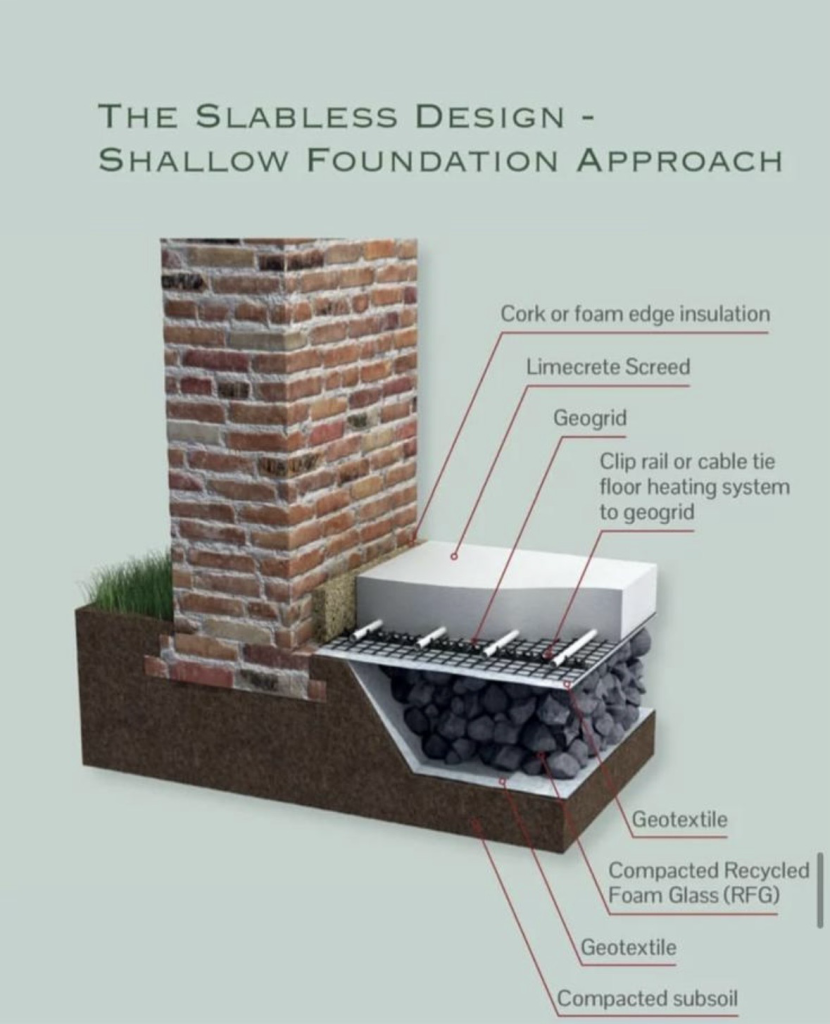
Instead of using a traditional concrete slab foundation, the system relies on multiple breathable layers to create a stable and insulated floor structure.
At the base of the system sits compacted subsoil. Above this is a geotextile membrane that separates the soil from the insulation layer. The insulation layer is typically made from recycled foam glass, which provides both insulation and drainage while allowing moisture to move through the structure.
Recycled foam glass is an important component within many modern limecrete sub floor systems, offering both environmental and performance benefits. Made from recycled glass, it provides a lightweight, highly insulating layer that also allows moisture to move freely through the structure. Unlike traditional insulation materials that can trap moisture, foam glass aggregate is vapour permeable and resistant to water absorption, making it particularly well suited to breathable floor construction. It also offers excellent load-bearing capacity while improving thermal efficiency, helping to create a floor system that is both structurally stable and compatible with the moisture-regulating principles of lime-based construction.
A grid may then be installed to hold underfloor heating pipes in place.
The limecrete screed forms the upper structural layer of the floor, while cork or foam insulation around the perimeter creates a thermal break and helps reduce heat loss.
Limecrete and Underfloor Heating
Limecrete floors can work very effectively with underfloor heating systems.
Because limecrete has good thermal mass, it absorbs heat and releases it gradually into the room. This helps maintain consistent indoor temperatures and improves comfort.
Underfloor heating pipes are typically secured to a grid before the limecrete screed is installed.
Frequently Asked Questions
What is the difference between limecrete and concrete floors?
The main difference is breathability. Concrete forms an impermeable barrier that prevents moisture from passing through the floor, while limecrete allows moisture vapour to move through the material and evaporate naturally.
Is limecrete suitable for old houses?
Yes. Limecrete is particularly suitable for historic buildings because it allows the structure to breathe and prevents moisture from becoming trapped within the building fabric.
Can limecrete be used with underfloor heating?
Yes. Limecrete works well with underfloor heating systems because its thermal mass allows it to absorb heat and release it gradually.
Is limecrete environmentally friendly?
Limecrete can be more environmentally friendly than concrete because lime production typically requires lower firing temperatures and lime absorbs carbon dioxide during curing.
How long does limecrete take to cure?
Limecrete cures more slowly than concrete. It gains strength gradually through hydration and carbonation, which can take several weeks depending on environmental conditions.
Conclusion
While limecrete and concrete may appear similar once installed, their behaviour as building materials is fundamentally different. Concrete creates a rigid and impermeable barrier that works well in many modern construction projects, but it can cause problems in buildings that rely on breathable materials. Limecrete provides a vapour permeable flooring solution that allows moisture to move naturally through the structure, helping protect traditional building materials and maintain the long-term health of historic properties.
For projects involving heritage buildings, renovations, or sustainable construction, understanding these differences is essential when choosing the most appropriate floor system. If you are considering installing a limecrete floor or would like expert advice on whether limecrete is suitable for your project, you can request further information through our Get a Quote page.